Manage your decisions, not your vehicles.
Food Distribution
You find out what this morning decision cost you at the end of the month
Your dispatcher sits down to the same question every morning: which vehicle goes where today. The answer comes from experience and the plan holds on most days. On the days it does not, nobody knows exactly why. The real problem is not that the plan is wrong. It is that the cost of the plan is written down nowhere. Velocost puts that number in front of you before you release the plan.
In our sample data set, 55 deliveries across 16 vehicles. The lowest cost plan comes to 97,198 TRY and the fastest plan to 107,468 TRY. The last delivery finishes 27 minutes earlier and that costs 10,270 TRY a day, because four more vehicles go out. Which one is right depends on what you promised the customer that day. What the product does is put both in front of the person making the call.
Cost picks the vehicle
Not every vehicle that can carry an order costs the same. Velocost prices fuel, tolls, driver hours, overtime and reefer consumption separately for each eligible vehicle. The load goes to the cheapest one, not to the first match in the list.
Customer rules are entered once
A customer may have a narrow dock, may refuse goods in the afternoon, may take half an hour to unload. Those rules never have to be typed into the daily order file again. They live on the customer card and flow into every plan that follows.
An unworkable plan is flagged up front
A plan that looks valid on paper may not hold on the road. If the driver day exceeds eleven hours, if the chilled compartment is full, if the delivery window has closed, Velocost says so before the plan goes out. The same warning appears on the driver route sheet.
Service time is learned from the field
The driver marks arrival and completion from the phone. Velocost derives each customer real unloading time from those marks and builds the next plan with it. Marks that are physically impossible are filtered out and never feed the learning.
Profit per customer becomes visible
Does a customer you drive forty kilometres for to drop three crates actually pay off? Velocost splits the route cost across stops by fuel, tolls, driver hours, door opening and waiting. Cost and gross margin per customer land in one table.
Your own plan becomes the baseline
You add the vehicle you gave each order to today as a plate column in your order file. Velocost prices your plan and its own plan with the same line items and puts them side by side. We do not quote the difference, it comes out of your own data.
Who it is for
This part was built for cold chain distributors, food wholesalers and producers who deliver to dealers with their own fleet. You can upload the file your vehicle tracking system or fuel card gives you as it is, and the columns are recognised even when the headers are named differently. No hardware has to be fitted and no system you already use has to be dropped. Whoever builds the morning plan keeps building it, with the cost already worked out.
Try it with your own fileBad Days
We did not build this on a calm day
Any dispatch plan looks right when the day goes well. The difference shows up on the day it does not. Velocost was built around the worst days of food distribution, and each of them is a check written into the code. If one turns red, the release does not ship.
Broken Chain Friday
It is 11:40 and the reefer unit dies mid route. Four customers have goods in that trailer.
The remaining load is transferred from where the truck actually stopped, not from the depot. A new plan is produced mid day and completed stops are preserved.
Yesterday’s Milk Does Not Ship Today
The order was meant to go yesterday. Its shelf life ends today.
An order past its delivery deadline never enters the plan. It stays on the carry over list with the reason attached.
It Arrived At 7 Degrees
The retailer measures temperature at the door. The limit for chilled goods is four degrees.
The driver enters the reading from the phone and it is written to the stop. If the limit is exceeded it appears as evidence on the manager screen. No reading means no verdict.
Three Trucks At The Dock
The appointment is at nine and the driver arrives at 08:52. Unloading starts at 10:40.
Those 108 minutes are recorded against the customer, not against your service time. The learned unloading time stays at thirty minutes so later plans are not inflated.
Took Eight, Returned Two
Ten pallets went out and eight were accepted. Two pallets travel back in the trailer.
The order records eight pallets delivered. The two rejected pallets count against capacity on the return leg and only those two carry over to the next day.
Two Drivers Called In Sick
At six in the morning two drivers are absent. The trucks are ready and nobody is behind the wheel.
Absences enter the plan and a truck without a driver is not dispatched. If a third absence lands on the same day it is flagged as the record is saved.
We Wrote Pallets, Kilos Arrived
The order is in kilograms and the trailer measures pallets. The two cannot be compared.
A line whose measure cannot be compared is kept out of the plan and listed as a unit mismatch. It is not quietly loaded and left at the door.
No Trucks Before Ten
The customer appointment is at 08:30. The city bans trucks from that street in the morning.
The ban window enters the plan as a constraint. If the truck has to wait it out, the waiting time is costed and the appointment breach is visible in advance.
Twenty six bad days, twenty six checks
Eight of them are above. There are twenty six in total and all of them run in an automated suite. If one of these checks turns red while a new feature is being added, the release does not ship. Loosening an expectation to make a check pass is not allowed, because that removes the reason the test exists.
Request a demo environmentPlatform
What's actually in the app
Screenshots straight from the real Cockpit — not mockups.
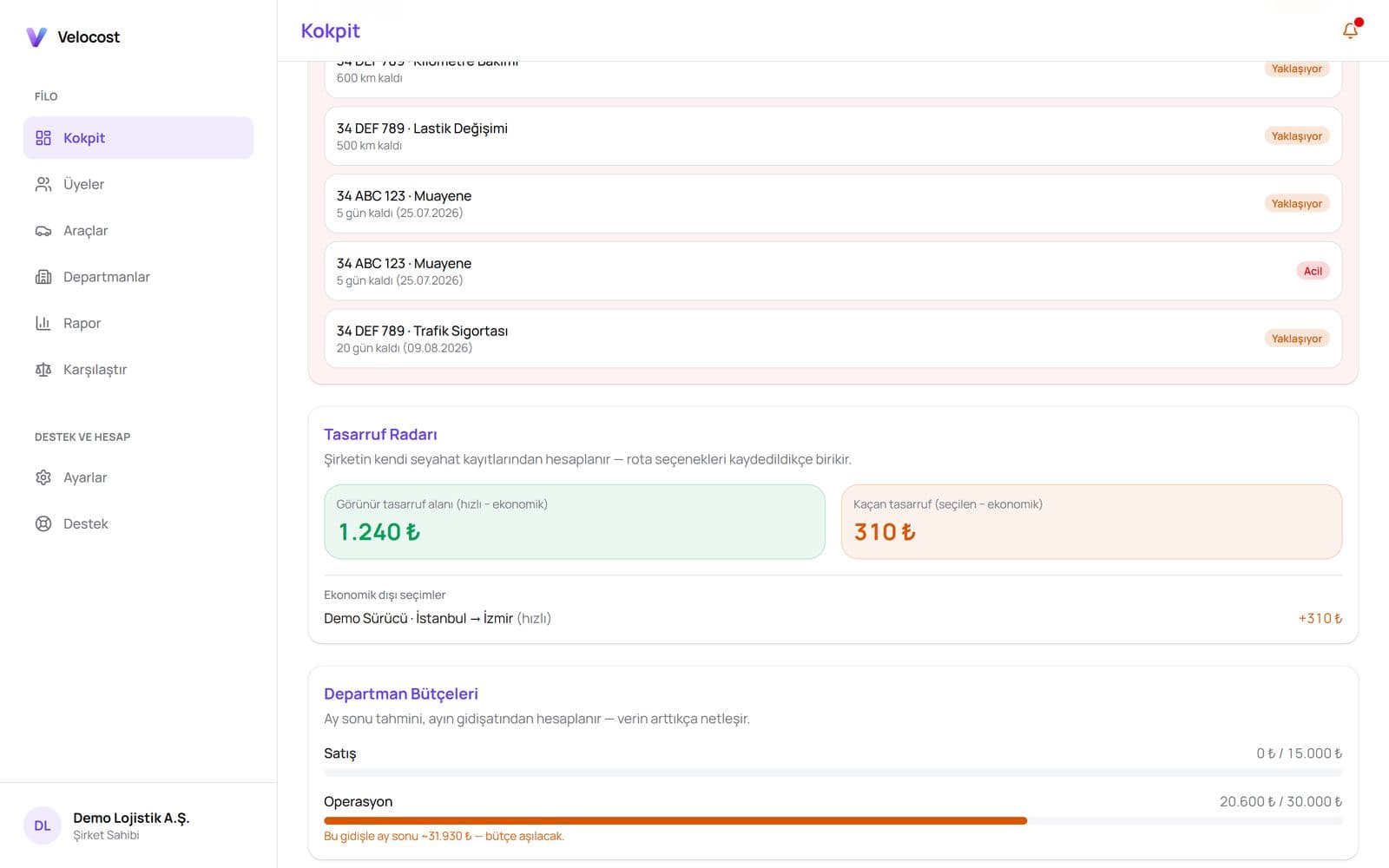
Cockpit and Savings Radar
Compare this month's total cost against last month, see the budget run-rate before the month ends. Savings Radar shows the amount leaked to non-economical route choices, separately from savings actually realized.
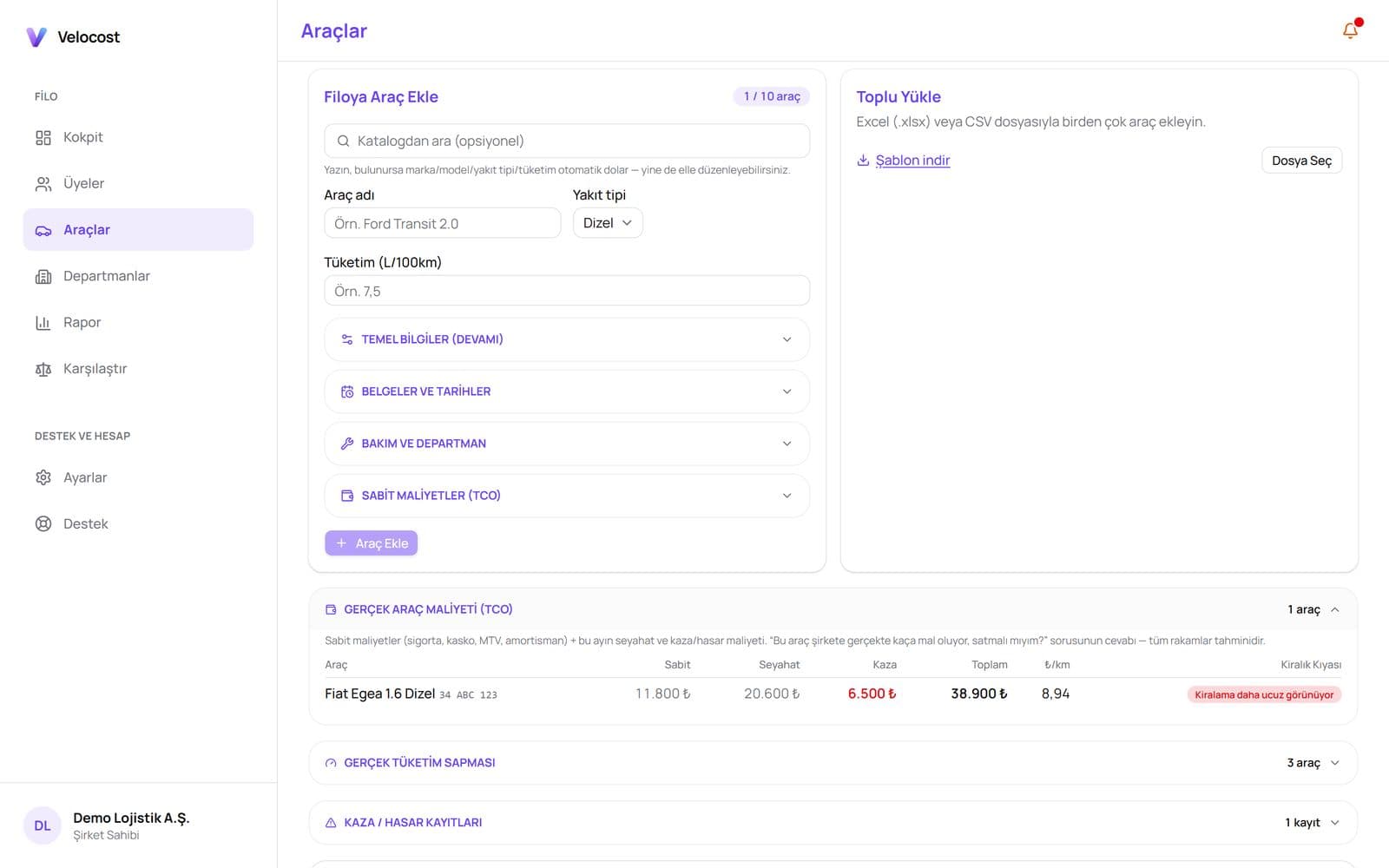
Real vehicle TCO and rental comparison
Insurance, kasko, road tax and depreciation blend with that month's trip and incident costs into a true cost per km for every vehicle. The monthly equivalent is compared against renting a similar vehicle, and the better option is flagged.
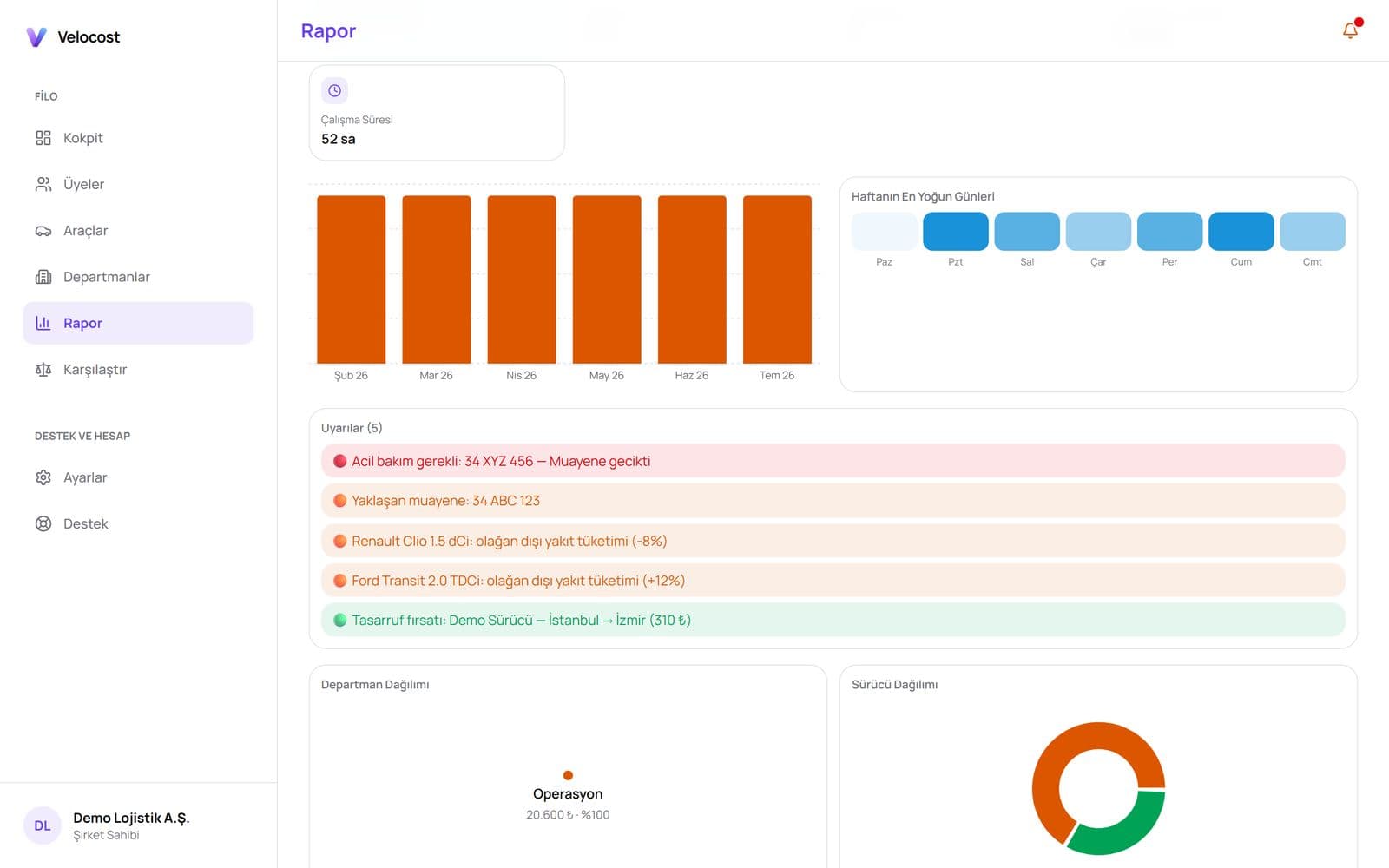
Day, week, month, year — full reporting
A period trend chart, a heatmap of the busiest days of the week, department/driver/vehicle/route distribution charts, CO₂ and cost-per-km averages — all on one screen. Budget run-rate flags an overrun before the month ends.
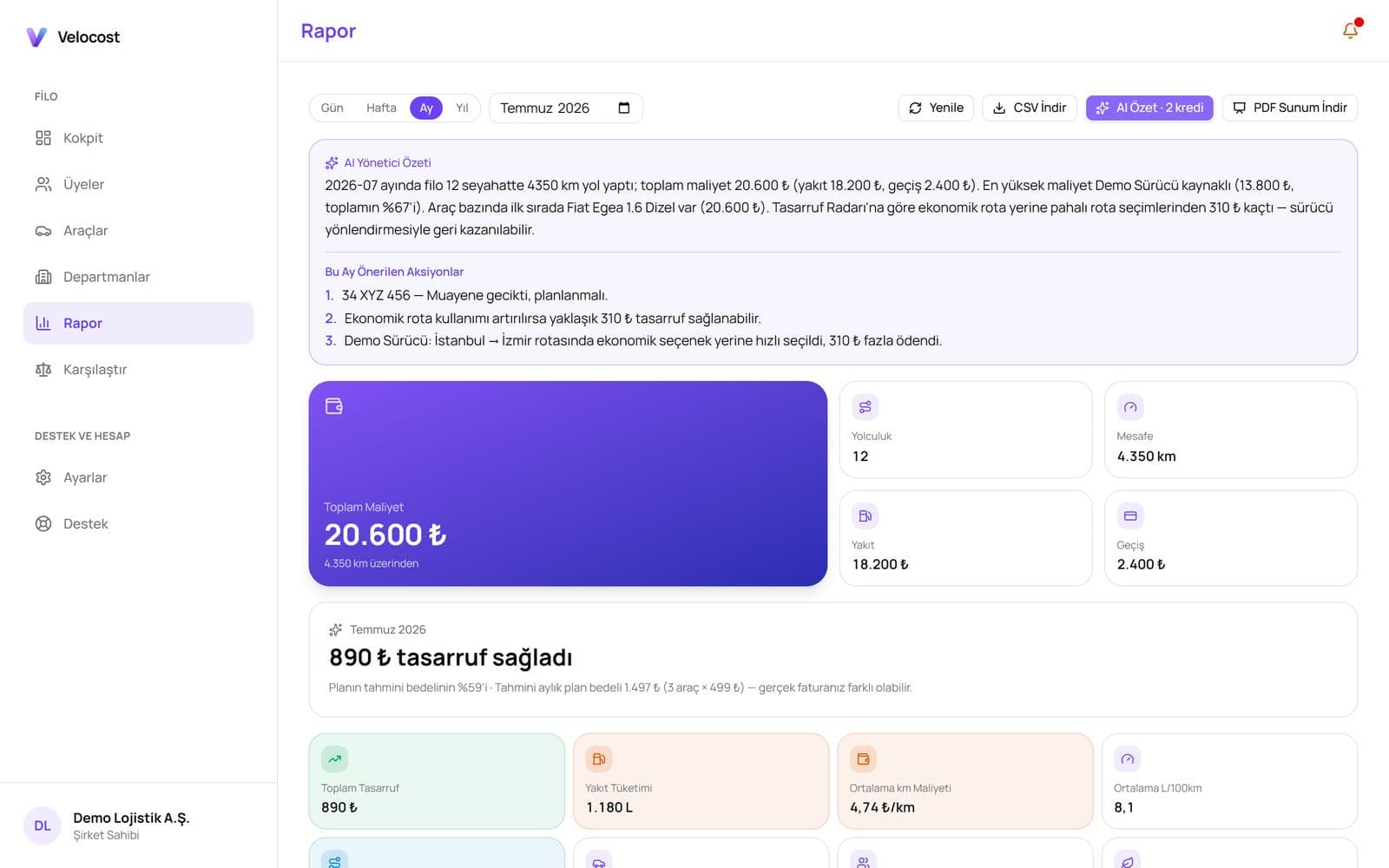
AI executive summary and Boardroom Mode
One click gives you the monthly summary and up to 5 recommended actions. The 11-page PDF executive report closes with a dark, meeting-ready Boardroom Mode page.
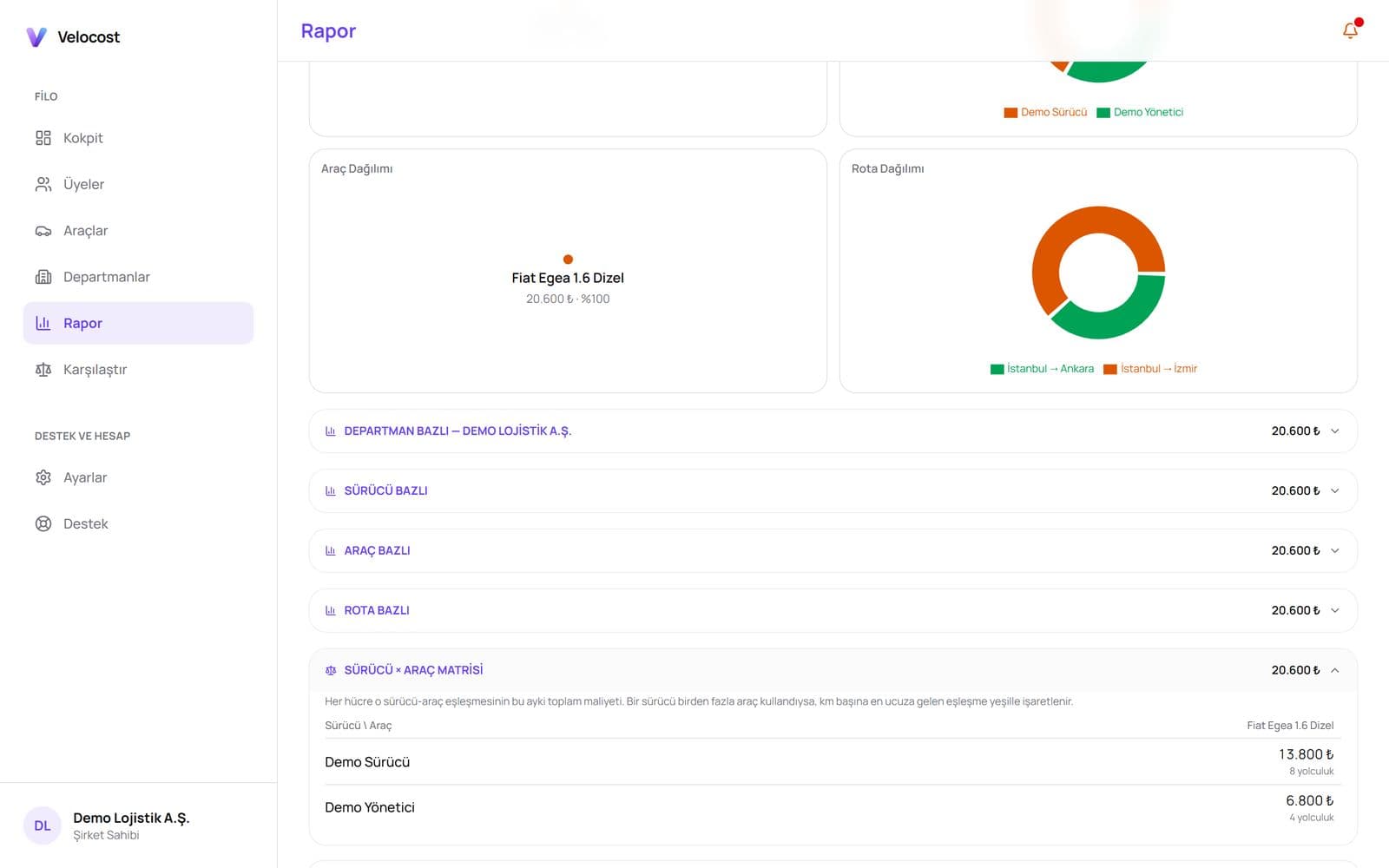
Driver × vehicle matrix and risk cost
See which driver-vehicle pairing costs the most in a single table. Incident and damage records automatically roll up into a driver risk cost — not a logbook, a decision signal.
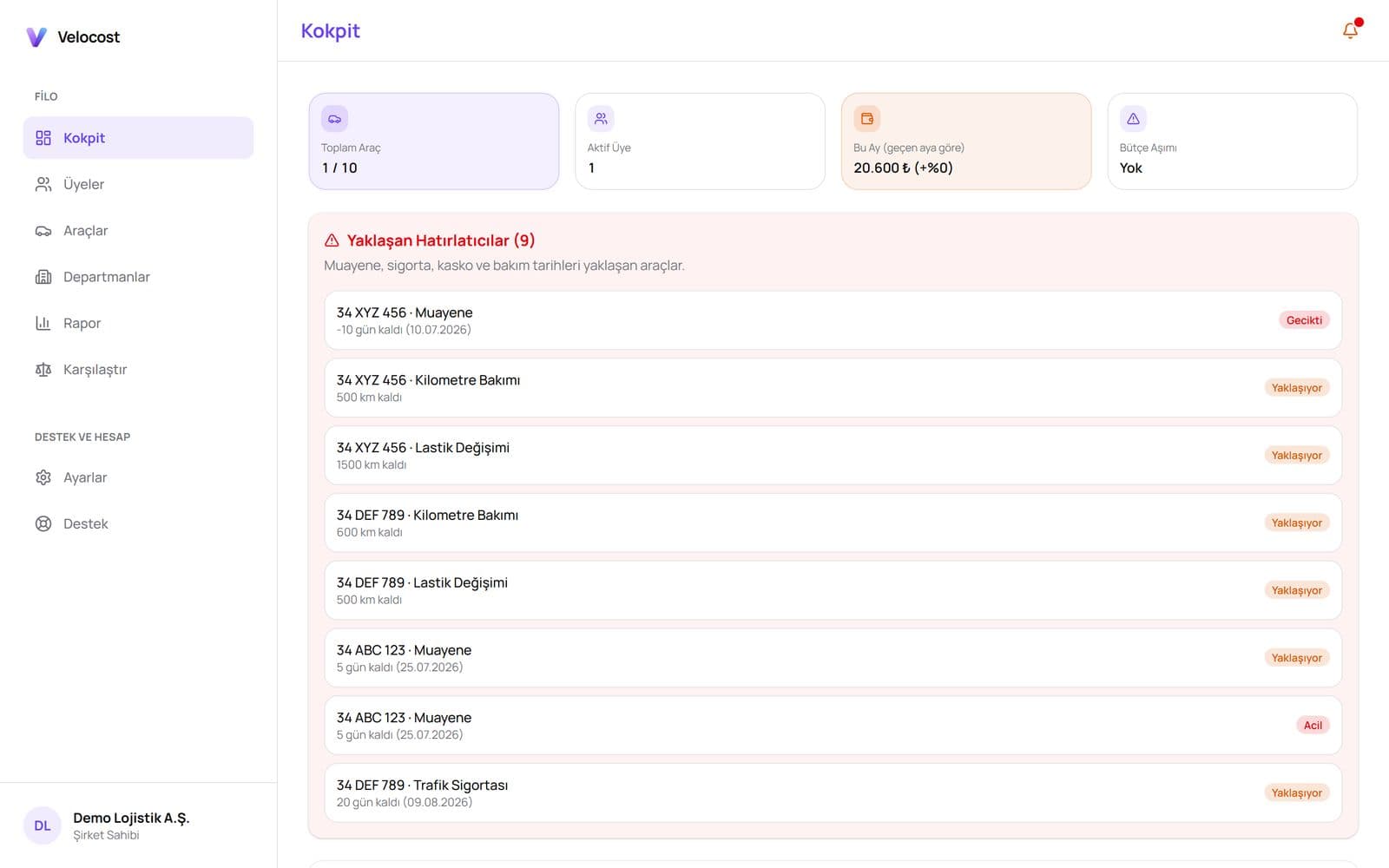
Reminders and bulk vehicle upload
Get alerted as inspection, insurance, kasko, service and tire-change dates approach. Upload your whole fleet at once with an Excel or CSV template instead of entering vehicles one by one.
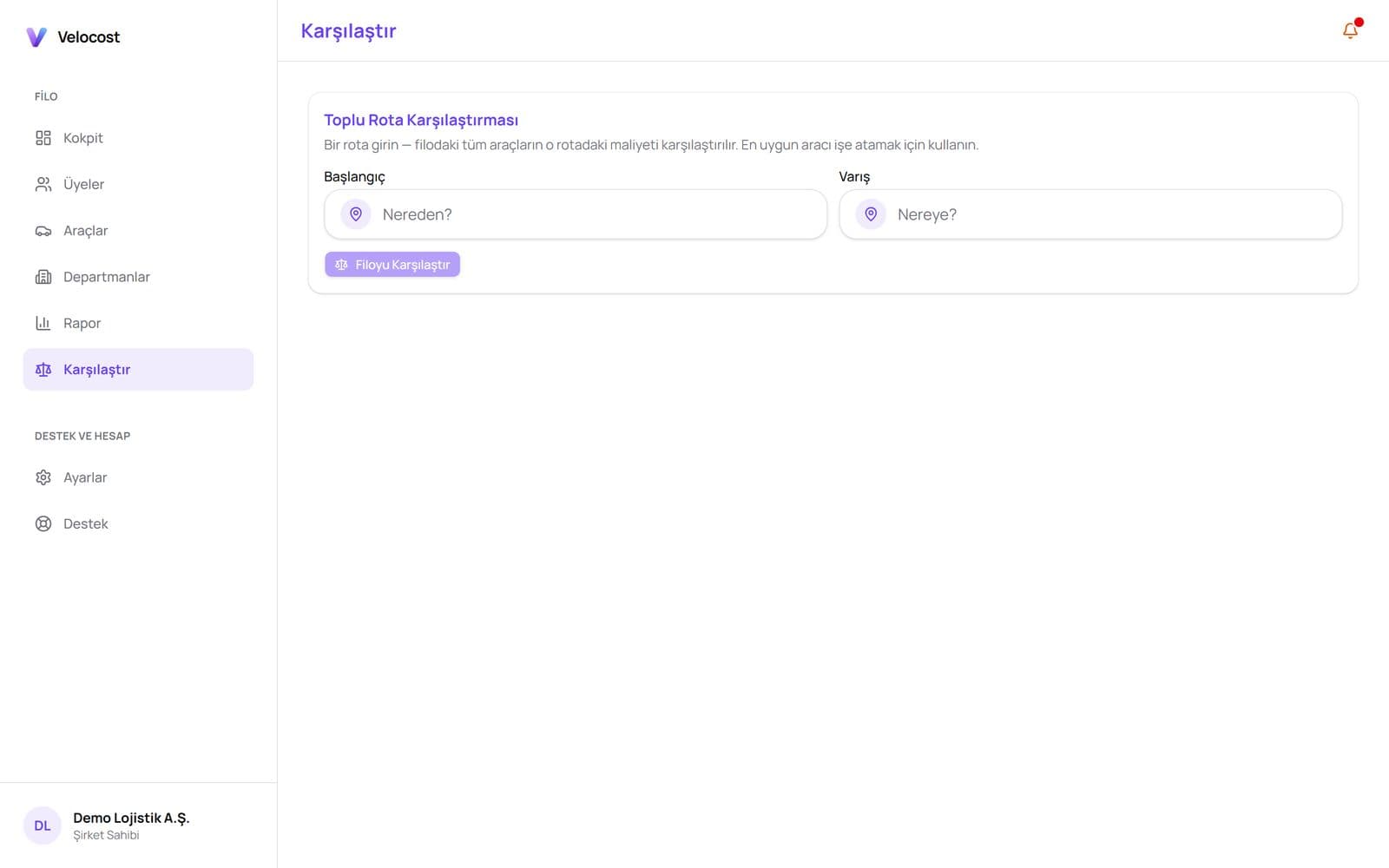
Approval flow and heavy-vehicle routing
Planned trips go to the manager for approval; a "worth it?" verdict is computed automatically from the driver's hourly cost. Truck and bus routing works with axle, tonnage and height data.
Velocost Fleet
The fleet plan that manages your decisions, not your vehicles — priced by fleet size
- All Pro features included
- Driver and manager invites scaled to your fleet — no hardware, live the same day
- Automatic vehicle + driver assignment and stop sequencing from your daily shipment list
- Cold-chain aware planning — frozen/chilled/ambient delivery order is preserved
- Capacity, delivery windows, shifts and special equipment (tail lift/ADR) solved together
- Shipment cost across 8 line items — reefer unit and overtime included
- Objective picker: lowest cost / shortest time / fewest vehicles — the gap shown in money
- Manual-assignment benchmark + a reasoned list of shipments that did not fit the plan
- Shipment list upload (Excel/CSV) — addresses geocoded automatically
- Vehicle–driver assignment and tracking
- Truck/bus routing (axles, tonnage, height)
- Departments + monthly budgets, overrun alerts and run-rate projection
- Day/week/month/year reporting + trend chart, heatmap, distribution charts
- One-click AI executive summary + up to 5 recommended actions
- 11-page PDF executive report + Boardroom Mode
- Savings Radar — shows missed and realized savings separately
- Real per-vehicle TCO, cost blended into a true cost per km, plus own-vs-rental comparison
- Driver × vehicle cost matrix
- Driver risk cost from incident/damage records
- Real consumption deviation — computed from fuel logs, no hardware
- Inspection, insurance, kasko, service and tire reminders
- Bulk vehicle upload (Excel/CSV template)
- Manager approval flow for planned trips + time-value verdict
- Whole-fleet cost comparison in one query
- Monthly credits set by fleet size + email support
Both buttons open a pre-filled email to our sales team — no hardware, setup happens the same day.
Fleet FAQ
Write to us: info@urastech.com